| CPC G08G 1/0141 (2013.01) [G08G 1/0112 (2013.01); G08G 1/162 (2013.01); G08G 1/166 (2013.01)] | 30 Claims |
|
1. A method of controlling a vehicle, comprising:
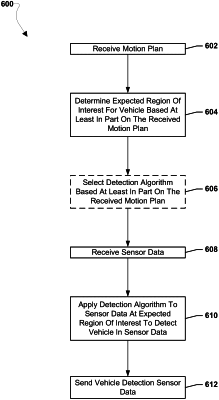
receiving an intention message including a motion plan from a transmitting vehicle,
wherein the motion plan comprises a trajectory of the transmitting vehicle and one or more vehicle descriptors associated with the transmitting vehicle and wherein the one or more vehicle descriptors comprise a vehicle physical capability,
wherein the vehicle physical capability comprises at least one of a turning radius, a vehicle top speed, and a vehicle maximum acceleration;
parsing the intention message to identify the motion plan for the transmitting vehicle;
determining an expected region of interest for the vehicle based at least in part on the motion plan;
selecting a first detection algorithm for detecting a sensor perceptible attribute of the transmitting vehicle based on receiving the motion plan of the transmitting vehicle,
wherein the first detection algorithm is associated with a first confidence threshold for reporting detection of the transmitting vehicle in the expected region of interest,
wherein the first confidence threshold is lower than a second confidence threshold associated with a second detection algorithm;
receiving sensor data from one or more sensors disposed in or on the vehicle;
applying the selected first detection algorithm to a limited subset of received sensor data from the expected region of interest;
setting a future behavior prediction for the transmitting vehicle based at least in part on a vehicle behavior model for the transmitting vehicle limited by the vehicle physical capability and the expected region of interest, wherein setting the future behavior prediction for the transmitting vehicle is based on the application of the selected first detection algorithm; and
controlling the vehicle based at least in part on the motion plan and the future behavior prediction.
|