US 12,468,045 B1
Utilizing GNSS risk analysis data for facilitating safe routing of autonomous drones
Matthew Pottle, Paignton (GB); Esther Anyaegbu, Northampton (GB); Colin Richard Ford, Carmarthen (GB); Paul Hansen, Cambridge (GB); Ronald Toh Ming Wong, Paignton (GB); Jeremy Charles Bennington, Greenwood, IN (US); and Samuel Nardoni, Paignton (GB)
Assigned to Spirent Communications PLC, Crawley (GB)
Filed by Spirent Communications PLC, West Sussex (GB)
Filed on Sep. 19, 2022, as Appl. No. 17/948,213.
Application 17/948,213 is a continuation in part of application No. 17/706,421, filed on Mar. 28, 2022, granted, now 11,802,972.
Application 17/706,421 is a continuation of application No. 17/374,885, filed on Jul. 13, 2021, granted, now 11,287,531, issued on Mar. 29, 2022.
Claims priority of provisional application 63/407,579, filed on Sep. 16, 2022.
Claims priority of provisional application 63/161,386, filed on Mar. 15, 2021.
Claims priority of provisional application 63/051,849, filed on Jul. 14, 2020.
Int. Cl. G01S 19/08 (2010.01); H04L 67/12 (2022.01); G08G 1/0968 (2006.01)
CPC G01S 19/08 (2013.01) [H04L 67/12 (2013.01); G08G 1/0968 (2013.01)] 19 Claims
OG exemplary drawing
 
1. A method of routing an autonomous drone using GNSS data by using a worst-case of risk analyses for planning, the method including:
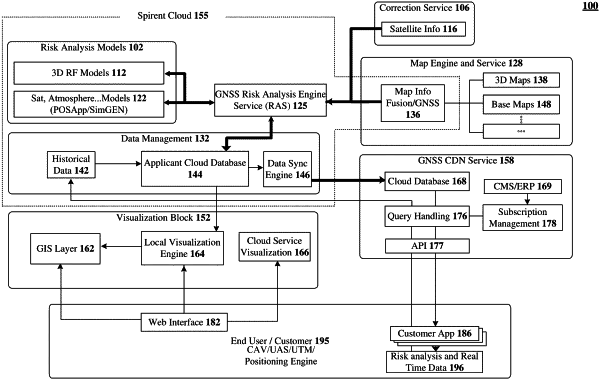
obtaining from a risk analysis server a worst-case risk analysis, covering a selected period, responsive to a requested area, wherein the worst-case risk analysis identifies cuboids in an area through which a drone can fly throughout the selected period with GNSS coverage that meets a coverage threshold that is specified as adequate for autonomous flight guidance;
identifying, by a first routing algorithm, a route through the cuboids identified as having the adequate GNSS coverage, from a starting location to a destination.