| CPC G02B 27/0101 (2013.01) [G02B 5/1866 (2013.01)] | 12 Claims |
|
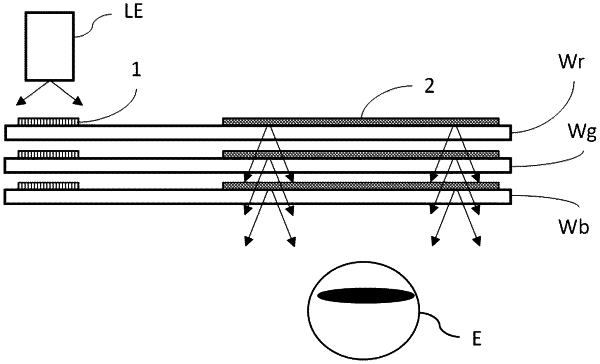
1. A near-eye display waveguide device, comprising m waveguide substrates stacked on each other, m being an integer and m>3, the near-eye display waveguide device receiving image-carrying light with an image field of view angle range, and the image-carrying light comprising light of less than m dominant wavelengths, wherein:
corresponding to each dominant wavelength, the m waveguide substrates are formed with at least two coupling-in gratings, the at least two coupling-in gratings are formed on different waveguide substrates and have different grating periods, for being used to couple light in different coupling-in field of view angle ranges into the corresponding waveguide substrates, wherein the coupling-in field of view angle ranges are each smaller than the image field of view angle range, and the coupling-in field of view angle ranges as a whole cover the image field of view angle range;
the m waveguide substrates are waveguide substrates Wi, i is an integer and 1≤i'm, wherein,
for i=1, a coupling-in grating G(1,1) for a dominant wavelength λ1 is formed on a waveguide substrate W1, and the coupling-in grating G(1,1) has a grating period d1;
for i=m, a coupling-in grating G(m-1,2) for a dominant wavelength Am-1 is formed on a waveguide substrate Wm, and the coupling-in grating G(m-1,2) has a grating period dm; and
for 2≤i≤m−1, a coupling-in grating G(i,1) for a dominant wavelength Ai and a coupling-in grating G(i−1,2) for the dominant wavelength λi−1 are formed on the waveguide substrate Wi, and satisfy: λi-1>λi>λi+1, wherein, for 2≤i≤m−1, the coupling-in grating G(i,1) and the coupling-in grating G(i-1,2) have different grating structure features, and the grating structure features comprise one or more of depth, height, duty cycle, blaze angle and optical coating of the gratings;
wherein, for 2≤i≤m−1, the coupling-in grating G(i,1) and the coupling-in grating G(i−1,2) have the same grating vector direction and grating period di, and di−1>di>di+1, and wherein, for 1≤i≤m−1: λi/di is approximately a constant C1, and/or Ai/di+1 is approximately a constant C2, wherein a deviation is within ±5%.
|